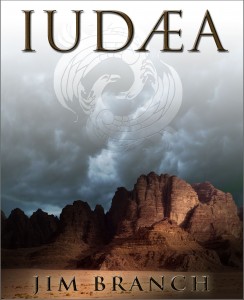
  If you would like to read the entire story I’ve put the full text out on Amazon’s Kindle store.  You can find it here or click on the link in the sidebar.  I’ve priced this electronic version at $8.75 and hope you will check it out.
 If you would like to read the entire story I’ve put the full text out on Amazon’s Kindle store.  You can find it here or click on the link in the sidebar.  I’ve priced this electronic version at $8.75 and hope you will check it out.
I also revised the first few paragraphs of Chapter 1 in an attempt to make the novel’s introduction more inline with the overall tone of the story. Â Here is the revised version of Chapter 1:
Britannia, AD 133
I was tired and my back was sore from the day’s ride.  The horses plodded along the ridge, their hooves slapping at the muddy ground.  The sweat under my leather armor was beginning to make me  cold as the fog rolled into the lower valleys and the clouds thickened overhead.  It was late afternoon, and I felt rain drops as Speratus held his sword above his head and looked out to the north.
There were sixteen of us, half the unit, with Speratus, our decurion and commanding officer, in the lead.  His red cloak billowed in the wind as conspicuous as a rooster’s crest while he waved  his sword to get our attention.  He pointed to just below the horizon.  I was the duplicarius, second in command, and in the back keeping the men in line.
Through the mist I could barely make out a small cart being pulled by a mule, a handful of men walking alongside. Â We turned our mounts off the ridge and down a steep slope. Â The horses jumped and slid to keep their footing. Â When I looked up again the men with the cart were running, whipping the mule to go faster. Â They were heading for the treeline and a small opening in the brush where the trail disappeared into the woods. Â We urged the horses into a full gallop across the plain between us and the brigands, dodging tree stumps and mudholes that had been left from when the forest was cleared for timbers and firewood. Â My discomforts melted away as my heart began to pound in time with the hoof beats.
The cart was well into the woods by the time we reached the trail which was more of a small muddy stream than a serviceable path.  We barreled into the narrow opening.  I leaned close to my horse, Tempest, and cut away branches and briars with my sword. What little sunlight there was disappeared, and my eyes slowly adjusted to the dark woods. Not more than a couple hundred feet ahead of us, I saw a bright spot in the thick canopy. The ruts left by the cart led into a clearing. We rode into the glen, and Speratus swung his sword above his head instructing us to fan out. The clearing was encircled by bunches of blackberries and other thorny shrubs. The mule stood harnessed to the cart in the center of the meadow munching on the wet grass, oblivious to the horses.
Our six archers readied arrows and scanned the woods beyond the underbrush. We knew it was an ambush, but it was going to take more than a bunch of muddy brigands to defeat fully trained, Roman cavalry.  For a moment, everything was silent except the heavy breathing of the horses. The rain had died to a light drizzle, and the woods beyond the clearing were dark and full of mist. I heard the bow creak before I saw the first arrow. I turned Tempest toward its source and jabbed my heels into her sides. We lurched forward. My shield protected my head and torso. Guttural screams echoed off the trees. Arrows whizzed by in all directions, and my shield shuddered as they stuck in the wood. I urged Tempest toward the edge of the clearing. She vaulted over the brambles. Thorns cut her belly, as she crashed to the other side. Landing outside the clearing, I saw two men drawing their next arrows, one on either side of me. I swung my sword at the one on the right splintering his bow and knocking him back. The other one ran for cover giving me the advantage.  Using the bottom of my shield, I opened a bloody gash on the back of his head. He stumbled and fell to the ground.
Before I could pull up, a giant of a man charged out from behind a large oak. He was bare-chested and standing his ground. He swung a large axe and screamed like a banshee. The axe sunk deep into Tempest’s chest. She rolled forward tossing me out of the saddle. I used my shield to ease the fall and rolled away from the madman, but before I could get up, the axe sliced toward me. On one knee, I held up my shield and braced myself. The axe caught the edge of my shield and ripped it off my arm leaving a long red burn from my elbow to my wrist. The axe came at me again. I rolled to the side. It clipped my scale armor and sunk into the forest floor. I slashed back wildly managing to nick him in the side. In one motion, he ripped the axe from the ground and swung it again. I jumped back hitting a tree. The axe came within inches of my face and sprayed me with mud. Continuing the motion, he brought the axe over his head and then down toward my skull. I dropped to the ground; the axe sunk into the tree. His abdomen exposed, I drove my sword into his chest under his ribs. His expression shifted from rage to surprise, as he looked down at my sword. He let go of the axe with his left hand and grabbed my shoulder. The bastard was strong. I couldn’t pull away. The surprise left his eyes, and his right hand reached for a large knife at his waist. He raised the knife above his head.  Instead of trying to get away, I pushed my sword up to the hilt. The point came out his back, and he slumped over. He stunk of sweat and dung, and I twisted to the side to slough him off. He fell to the ground like he was made of lead.
Remembering the other archer, I turned to look for him. He was standing on the other side of Tempest looking down at the dead man with a dumb look on his face.  Before I could stand up and straighten my armor, he turned and bolted into the woods. He had no armor and no weapons besides the broken bow. He would easily outrun me, so I picked up a dead branch off the ground and threw it at his legs. I got lucky. It caught him behind the knees, and he fell into the underbrush. I had my sword at his back before he could stand. He rolled over to face me, and I realized that he was not more than sixteen, no older than my eldest son.
I told him to get up, using my sword to show him what I meant in case he didn’t speak Latin. I prodded him back to where Tempest was laying on a blanket of blood-soaked leaves. The fighting was over, and I only saw our men cleaning their swords. Speratus walked out from around the brambles and over to the dead man.
He kicked the behemoth in the side, “Impressive work. Are you alright?â€
“I’m fine. He was all bluster and no finesse.†I knelt down next to Tempest. Her breathing was labored and choked with blood.
Speratus continued, “The bastards killed Marius, an arrow clean through the neck. And Sarkis got his leg pinned to his horse, shredded it up when he fell off, but he’ll live as long as he doesn’t bleed out. Lucius will take over as signifier for now.â€
He kept talking, but my attention was on Tempest. She had saved me more times than I could remember. She followed my every lead regardless of her own safety, and I led her right into that brigand’s axe. The wound was deep, and she wasn’t going to last much longer. I didn’t want to see her suffer, so I took my sword and placed the tip behind her left front leg. I drove it into her heart as quickly as I could. She shuddered and I felt the muscles in her neck go limp.
Speratus had stopped talking and was watching me, “Take Marius’s horse, he doesn’t need it anymore.â€
I nodded. I pulled some rope from my saddle and went to the boy. He offered no resistance as I bound his hands, but he kept looking over at the other archer, who was starting to moan and roll his head.  Speratus walked over, pulling a knife from his belt. The boy’s eyes grew wide, and I turned just as Speratus pulled the man’s head back and slit his throat like a freshly pinned deer. The boy lurched forward and screamed the Celtic word for father. I recognized it because it was what my sons called me. They’d learned it from their mother, who was born into a local Celtic tribe called the Brigante. I held the boy back. I knew Speratus would not hesitate to do the same to him if provoked. The boy dropped to his knees, tears welling up in his eyes.
I turned to Speratus, “What did you do!â€
He casually cleaned the blade of his knife, “What? He tried to kill you. Given the chance, he’d just as soon slit your throat or mine. Besides, we don’t need a wounded Celt taking time away from our injured men.â€
“He was no threat to anyone. I thought we were supposed to civilize these people not murder them.â€
“Always the idealist. Why didn’t you try to civilize him?†Speratus pointed the knife at the man I killed. “These people don’t want what we have. They’re perfectly happy skimming off the edges and taking what doesn’t belong to them.†Looking down at the archer and then at the boy he continued, “An example has to be set so they know that we aren’t going to let them get away with it. Either they accept the rules, or they die resisting.â€
“Nice speech.  You do realize that was his father?†I said.
Speratus clenched his jaw, “Have you forgotten who is in charge here? My actions are not yours to question.â€
When he asserted his rank, I knew I’d pushed him far enough, and to some extent he was right. These men weren’t going to change their ways regardless if we tried to convince them with swords or rhetoric. They no more wanted the life of a Roman then I wanted the life of a Celt.
Speratus walked away. I went over to the man with the axe and picked up the knife he had intended for my back. As a Roman soldier and especially as the duplicarius, I was entitled to whatever loot I found on the battlefield. This benefit alone drove many of the soldiers. If they made it to retirement, they would get their citizenship, if they didn’t have it already, along with a nice piece of land and be able to live comfortably on all their spoils.
Most of the items I kept I passed along as gifts or offerings. I didn’t need a dead man’s belongings haunting me. If it was an admirable opponent I might keep some small trinket as a tribute, but most I gave to the legion to support the unit or left in shrines for Mirthras and Silvanus.
Passing back by the boy’s father, a glint of metal caught my eye. The boy was still on his knees, staring blankly at the ground. I rolled the man over and found an ornate sword and scabbard attached to his belt. I cut the belt and pulled the sword free. The handle was made of bronze with two fanciful heads at its base that curved back toward the center. The scabbard was even more impressive with two elaborately carved eagles twisted in an aerial battle. The sword was old but in good shape. Also around the man’s neck was an amulet. Wiping away the blood, I could see it was made of gold and engraved with strange marks. They didn’t appear to be Celtic runes, but it was made of gold and I could get a decent exchange for it.
I walked back over to the boy and pulled him to his feet.
“Someday boy, if the gods see fit, you’ll be able to earn this sword back.â€Â I cut away his bonds. “For now though, you at least deserve the right to bury your father,” I said.
